

There comes a point in every writer’s life when the greatest obstacle is no longer a lack of ideas. It is the constant noise of the analytical mind.
We edit before we write. We judge before we imagine. We question whether an idea is good enough before we’ve given it a chance to breathe.
For two years, the Green Mountain Writers Group explored a different approach through our weekly Flow-State Writing Workshops. Week after week, participants experienced creative breakthroughs. Writers who had struggled with writer’s block found themselves filling pages. Others discovered stories they never intended to write, remembered long-forgotten moments from their lives, or uncovered voices they didn’t know they possessed.
The lesson was remarkably consistent: when we stop trying to force creativity and instead create the conditions for it to emerge, something unexpected often happens.
The Green Mountain Writers Group is resuming our weekly Flow-State Writing Workshops, held every Tuesday evening from 7:00 to 9:00 pm.
These workshops are unlike a traditional writing class. There are no assignments. No outlines. No critiques. No pressure to produce a polished piece of writing.
Instead, we create the conditions in which authentic writing can emerge.
Listening Instead of Thinking
Most of us spend our days solving problems with our conscious minds. We analyze, compare, organize, and make choices. Those are valuable skills, but they are not necessarily the same mental processes that give rise to great writing.
Flow-State Writing begins with a different assumption: that the stories we are searching for may already exist somewhere beneath the constant chatter of everyday thought. Rather than forcing ideas onto the page, we quiet the analytical mind long enough to allow something unexpected to emerge. The meditation helps create that transition, and once the writing begins, there is no stopping to edit or reconsider. The goal is simply to keep the pen moving or the fingers on the keyboard until the forty minutes have passed.
Again and again, participants have told us that they were astonished by what appeared on the page. A memory they hadn’t thought about in decades suddenly became vivid. A fictional character began speaking with a voice of his or her own. An essay took a direction they had never consciously intended. These moments aren’t unusual. In many ways, they are the very reason for the workshop.
Symbolic Doorways to the Imagination
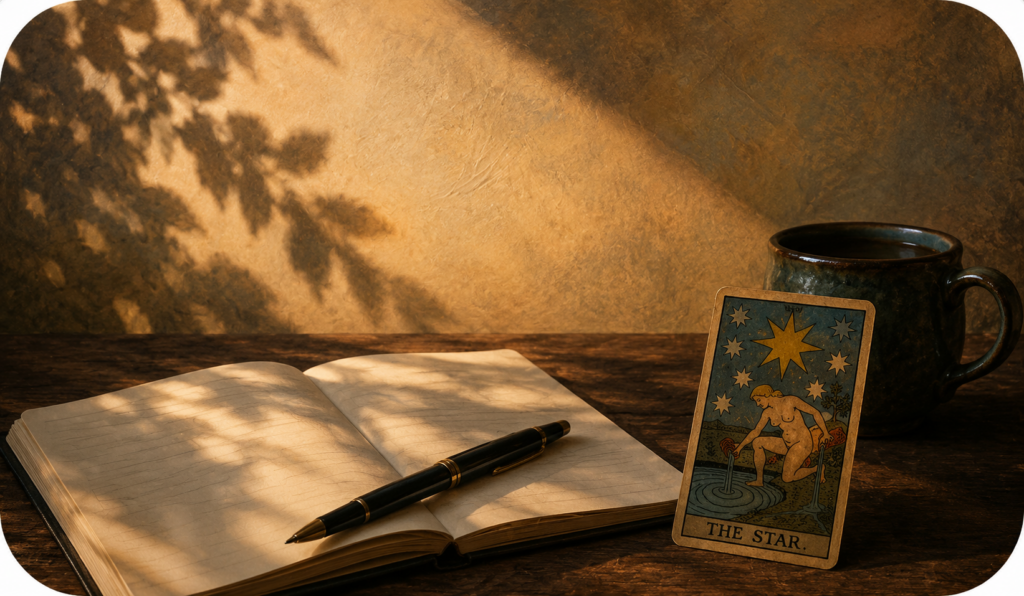
Occasionally, we begin the writing session by drawing one of the twenty-two cards from the Major Arcana. These cards are not used as fortune telling devices, nor are they intended as traditional writing prompts. Instead, they function as symbolic doorways. Many writers find the tarot very effective at breaking writer’s block.
Carl Jung devoted much of his life’s work to understanding archetypes, those recurring patterns that appear throughout mythology, literature, dreams, and human experience. The images of the Major Arcana can be viewed through that same lens. They do not tell us what to write. Instead, they awaken associations that are unique to each individual. One writer may see The Hermit and recall a solitary winter from childhood. Another may see The Star and begin writing about hope after loss. A third may look at exactly the same image and find themselves beginning a completely unexpected work of fiction.
The card never supplies the story. It simply opens a door. What lies beyond that door belongs entirely to the writer.
The Unexpected Threads Between Us
One of the most fascinating discoveries over the past two years has been what happens after a group develops a sense of trust and community. Although every writer begins the session independently and follows a different path, surprising connections often emerge when the work is shared. Similar metaphors appear. Common themes surface. Images echo from one writer to another, even though no one has written to the same prompt or discussed a common topic beforehand. Participants are frequently amazed to discover these unexpected threads weaving through the evening’s writing. Whether this is coincidence, the result of a shared creative atmosphere, or something deeper is left for each writer to decide. We simply know that it happens often enough that we’ve come to expect it.
Listening Without Judgment
The remaining time is devoted to sharing. Anyone who wishes may read what they have written, although no one is ever required to do so. This is not a critique group. We don’t analyze one another’s work or search for weaknesses. Instead, we simply listen. There is something surprisingly powerful about hearing a room full of writers who all began in the same silence arrive at entirely different destinations. Those readings often become a reminder that every writer carries a unique voice and a unique way of seeing the world.
The Stories We Already Carry
Over the past two years, the greatest lesson of Flow-State Writing has been that creativity is less about inventing something from nothing than it is about learning to recognize what has been quietly waiting within us all along. When we stop trying so hard to control the process, the imagination has room to do what it has always known how to do.
Join Us Tuesday Evenings
If you’ve been searching for a way to reconnect with your writing, overcome a creative block, or simply experience the joy of discovering words you didn’t know you had, we invite you to join us Tuesday evenings from 7:00 to 9:00. You don’t need to arrive with an idea. You simply need to arrive willing to listen.
The Psychology Behind Flow-State Writing
The inspiration for these workshops comes, in part, from the pioneering work of psychologist Mihaly Csikszentmihalyi (MEE-hah-li Cheek-SENT-me-hah-li) whose decades of research explored what he called flow or optimal experience. He observed that people are at their creative best when they become fully absorbed in what they are doing, so engaged in the activity itself that everything else fades into the background.
Writers often recognize this experience immediately. Concentration becomes effortless. The internal critic grows quiet. Self-consciousness disappears, and the words seem to arrive on the page almost of their own accord. Time itself begins to change. What feels like ten minutes may actually be forty, and when the timer finally rings, the most common response is, “Already?”
These are classic characteristics of the flow state. Attention narrows to the work itself. Distractions lose their power. The writer is no longer concerned about how the work will be judged, only with following where it leads.
While no one can force flow to happen, we can create the conditions that make it more likely. That is the purpose of these workshops. Through meditation, uninterrupted writing, a welcoming community, and an openness to surprise, we cultivate an environment where the imagination is free to do what it does best.
After two years of watching writers experience unexpected breakthroughs, we’ve come to believe that the greatest stories are often not the ones we plan. They’re the ones we discover.

Stephen Kastner writes essays, science fiction, memoir, poetry, and is currently working on a screenplay and novel about his Quaker ancestor Thomas Maule, who was arrested for defending the wise women accused of witchcraft in Salem in 1692. He leads the Green Mountain Writers Group in Vermont and creates digital media professionally as DesignWise Studios.
Follow his Antediluvian Attitudes on Substack: https://stephenkastner.substack.com