


I once heard Spike Lee talk to a room full of screenwriters about how to begin building a story.
He didn’t start with structure or theme. He started with something much simpler.
“Go to Staples,” he said, “or any office supply store, and buy a stack of three-by-five index cards.”
Keep them handy.
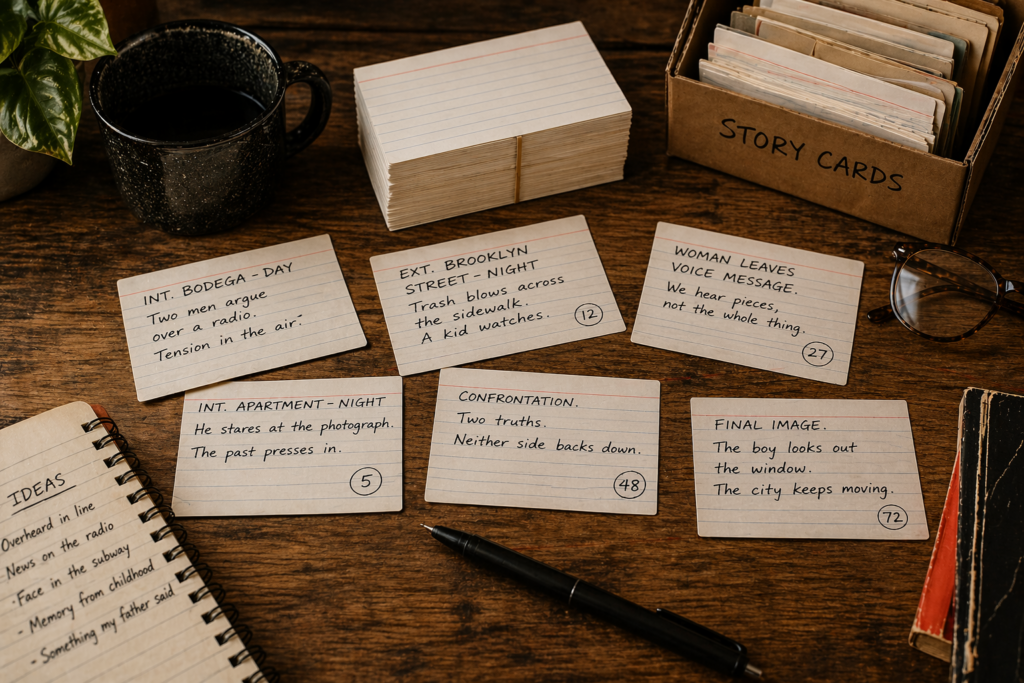
Every time you notice something, a line of dialogue, a strange moment, an image you can’t shake, write it down. One idea per card. No outlines. No planning. Just fragments.
- Something you overhear in a checkout line.
- A look between two people.
- A piece of tension in a room.
Capture it before it disappears.
Don’t worry about where it fits. Just collect.
Over time, you build a stack. And eventually, you begin to see something taking shape.
Spike’s 9 tips: “Write about what you know, keep working, and stay relentless”
What he teaches goes beyond the cards. It’s a way of working:
- Write about what you know. Start with what’s real to you.
- Accept that even a bad film is hard to make. Respect the work.
- If you want to direct, write your own material.
- For drama, put two people in conflict and make both sides believable.
- Get better with every project. No exceptions.
- Don’t let laziness creep in.
- Be relentless, focused, and committed.
- Use whatever tools you have. Even your phone. Just make something.
- If you go to film school, leave with finished work, not just a degree.
There’s a theme running through all of it: stop waiting and start making.
The 72-Card Method
Here’s where the index cards become something more than a collection.
Keep each card to one clear beat. A moment. A turn. A piece of movement.
When you reach 72 cards, you don’t just have notes.
You have a movie.
Now you can spread them out. Move them around. Rearrange. Cut. Replace. Discover the story instead of forcing it.
What you’re really building is momentum.
A simple 72-card structure
If you want a loose framework, you can shape your cards like this:
- Cards 1–12: Establish the world, the characters, and the central problem.
- Cards 13–24: Introduce complications and the first major turn.
- Cards 25–36: Increase pressure. Add conflict and reversals.
- Cards 37–48: Hit the midpoint. Raise the stakes with new information.
- Cards 49–60: Escalate toward crisis. Options narrow.
- Cards 61–72: Final confrontation, resolution, and closing image.
But the structure comes after the collection.
Not before.
The Real Lesson
The method isn’t about index cards.
It’s about paying attention.
It’s about trusting that small moments, gathered over time, can become something larger.
And it’s about doing the work, consistently, without waiting for permission.
One card at a time.

Stephen Kastner writes essays, science fiction, memoir, poetry, and is currently working on a screenplay and novel about his Quaker ancestor Thomas Maule, who was arrested for defending the wise women accused of witchcraft in Salem in 1692. He leads the Green Mountain Writers Group in Vermont and creates digital media professionally as DesignWise Studios.
Follow his Antediluvian Attitudes on Substack: https://stephenkastner.substack.com